

This event is part of HISPANIC GOLDEN AGE CLASSICS, a multi-part initiative of Red Bull Theater and Diversifying the Classics | UCLA. GET DETAILS HERE
This reading is produced in partnership with Diversifying the Classics | UCLA as a part of the 2026 LA Escena Festival.
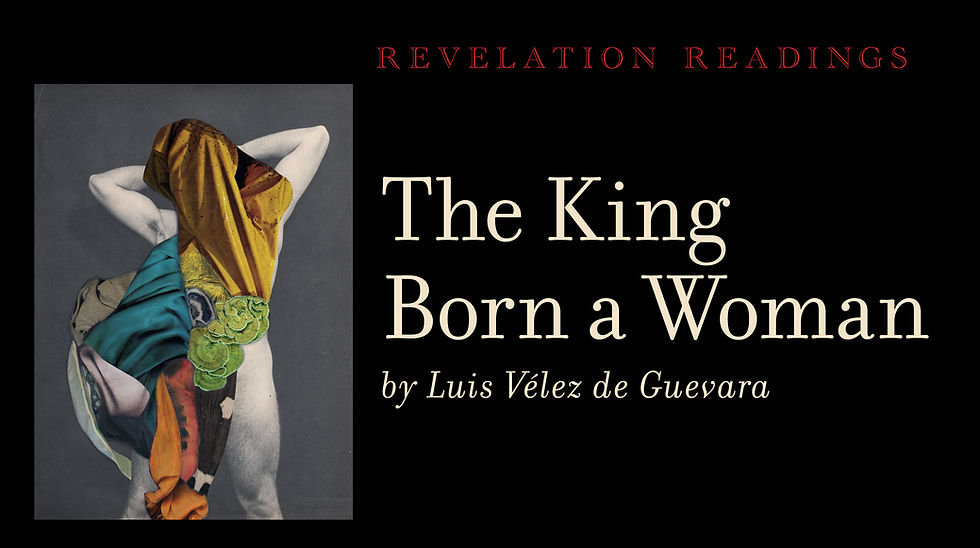
A subversive comedy from Spain's Golden Age presents medieval French history with a twist, exploring what truly makes a king. Charles the Fair is a dashing young monarch beloved by his subjects, but he has a big secret... An archaic law decrees that only a male can inherit the throne of France, forcing Charles - born Charlotte - to hide his birth gender from all. Romantic and political entanglements soon begin to complicate matters even more, threatening to bring the whole kingdom crashing down around him.
.jpg)

This event is supported by the
Cultural Office of the Embassy of Spain, and the Consulate General of Spain New York.
Livestream and On-Demand access made possible by the special support of the Michael Tuch Foundation.
This event will premiere LIVE from the Shiva at the Public Theater on Monday, October 5, 2026 at 7:00 PM ET. A recording will be available from Tuesday, October 6 at 7:00 PM ET through Sunday, October 11 at 11:59 PM ET. Open captions will be available from Wednesday, October 7 at 7:00 PM ET through Sunday, October 11 at 11:59 PM ET.
THE CAST


ABOUT THE PLAY
Vive le roi! In The King Born a Woman (El rey naciendo mujer), Spanish playwright Luis Vélez de Guevara (1579-1644) constructs an alternate history around the Salic Law, which prevented women from inheriting thrones and titles in France and other parts of Europe throughout the medieval and early modern period. The play flashes back several centuries to a crisis point, imagining a solution that transcends this rigid and exclusionary inheritance system. Writing for the Spanish court rather than the commercial theater, Vélez de Guevara also uses the play to question the valido system, which made royal favorites into shadow rulers who wielded tremendous power.
Twenty years before the start of the play, France desperately needed a male heir, and the then king made sure they got one, no matter what it took. Raised as the crown prince, King Charles the Fair now celebrates his 20th birthday and life is good, except for one thing – he must hide the fact that he was born a woman. And another thing - the French people hate his scheming and power-hungry favorite, Rugero, whom Charles is hopelessly in love with. And if that wasn’t enough, the English prince is storming the castle demanding Charles marry his sister. As internal rebellions, external invasions, and ungovernable emotions explode, the realm hangs in the balance, but will the heart win out? All's fair in love and war!
-RHONDA SHARRAH
ABOUT THE PLAYWRIGHT
Luis Vélez de Guevara (1579-1644) was a prolific dramaturg and poet of the Spanish Golden Age. After some early ventures into court poetry, young Vélez served as a soldier until 1603, when he returned to Spain and joined the royal court of Philip IV, finding a place with the Sandoval family, whose star member was the Duke of Lerma, the King’s favorite. Vélez served the Duke of Lerma’s second son, the Count of Saldaña, who was a patron of the arts and kept company with some of the Golden Age’s most celebrated writers.
Vélez’s connection to the royal court shaped his literary career: his early plays and poetry were often written to praise a specific nobleman or courtly celebration, perhaps to pledge literary allegiance to a specific patron and earn their financial backing. Vélez’s abundant production--more than 400 plays over the course of his life--earned him the respect of his contemporaries, including Miguel de Cervantes and Lope de Vega.
Vélez’s court plays reveal a deep fascination with aristocratic pomp and circumstance. No uncritical admirer, however, Vélez was most celebrated for work that satirized courtly mores. His 1622 play Reinar después de morir, for example, critiques dynastic marriage by making a tragic love story out of the historical affair between Don Pedro, prince of Portugal, and his beloved, a woman of illegitimate birth. Likewise, El diablo cojuelo, a satirical novel published in 1641, uses the figure of a limping devil and naive student to critique the widespread dissimulation and ensuing suspicion in Spanish society. The unlikely duo fly above Madrid, alighting on rooftops to spy on the city’s inhabitants and reveal the dissonance between their public personas and private habits. A biting satire on the customs of his time, Vélez’s El diablo cojuelo remains his most famous work.
The era’s heightened scrutiny dogged Vélez’s own public persona, for he was plagued by rumors that he was a converso, a Christian of Jewish heritage. Conversos were systematically excluded from many privileges, and faced the difficult challenge of proving their religious, cultural, and social fealty before their old Christian peers. Perhaps for this reason Vélez both celebrated virtuous leaders and challenged the prestige of lineage. Read in this light, El rey naciendo mujer becomes another in a series of texts to offer a nuanced, humanistic approach to leadership.
-BRENDA SARAÍ JARAMILLO
*The Working Group translators are: Marta Albalá Pelegrín, Raquel Cruz, Diana Echeverria Palencia, Barbara Fuchs, Brenda Saraí Jaramillo, Rachel Kaufman, Ruth Lopez, Laura Muñoz, Javier Patiño Loira, Victoria Rasbridge, Rhonda Sharrah, Rebecca Ogden Smith, Jesslyn Whittell, Sofía Yazpik

The LA Escena Festival of Hispanic classical theater will be back September 17-October 5, 2026. The fifth edition of Diversifying the Classics’ biennial festival will bring exciting new works by international artists and Los Angeles playwrights to UCLA’s MacGowan Hall theaters in Westwood, Los Angeles.
LA Escena is Los Angeles’ first Hispanic classical theater festival, organized by UCLA’s Diversifying the Classics, which is part of the Division of Humanities. Since the inaugural edition in 2018, LA Escena has brought the best of Southern California theater together with acclaimed performers from around the world to celebrate the comedia in performance and adaptation.
This year LA Escena will offer productions by theater companies from Mexico, Spain, and the United States, including three new adaptations from our popular Golden Tongues series, as well as premiering our new translation of The King Born a Woman by Red Bull Theater, streaming from New York City.